

Moving With Kids · September 2, 2026
Moving With Kids: A Practical Survival Plan for Moving Week
A practical system for keeping kids comfortable, essentials accessible, routines intact, and moving-day chaos under control.
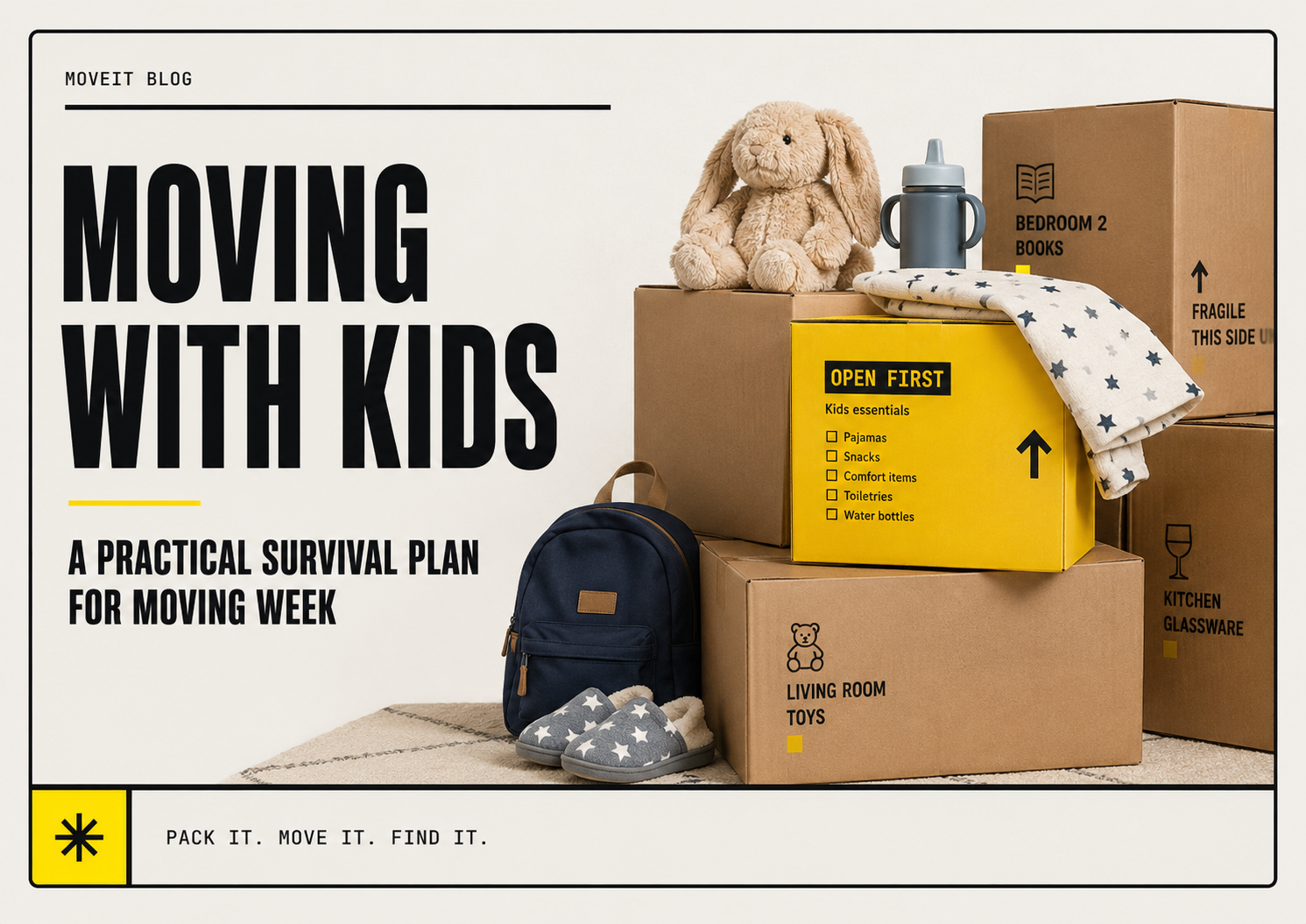
Moving with kids changes the job.
You are not only moving furniture, boxes, documents, and a household. You are also trying to keep meals happening, favorite toys findable, bedtime recognizable, school items accessible, and everyone reasonably calm while the house around them disappears into cardboard.
The solution is not to make moving week perfect.
It is to make the important things predictable.
A good moving plan for children protects three things:
- Routine — the parts of the day that still feel normal.
- Access — the things your child may need immediately.
- Familiarity — the objects, foods, bedding, and rituals that make a new place feel less strange.
Child Mind Institute recommends giving children as much age-appropriate control as possible, keeping routines such as meals and bedtime where you can, and getting familiar belongings out quickly after arrival. The American Academy of Pediatrics similarly emphasizes the value of predictable family routines during periods of change.
This guide turns those principles into a practical moving-week system.
MoveIt rule: if your child might need it before the house is fully unpacked, do not let it disappear into an anonymous moving box.
01Start With the 3-Bag Systemexpand_more
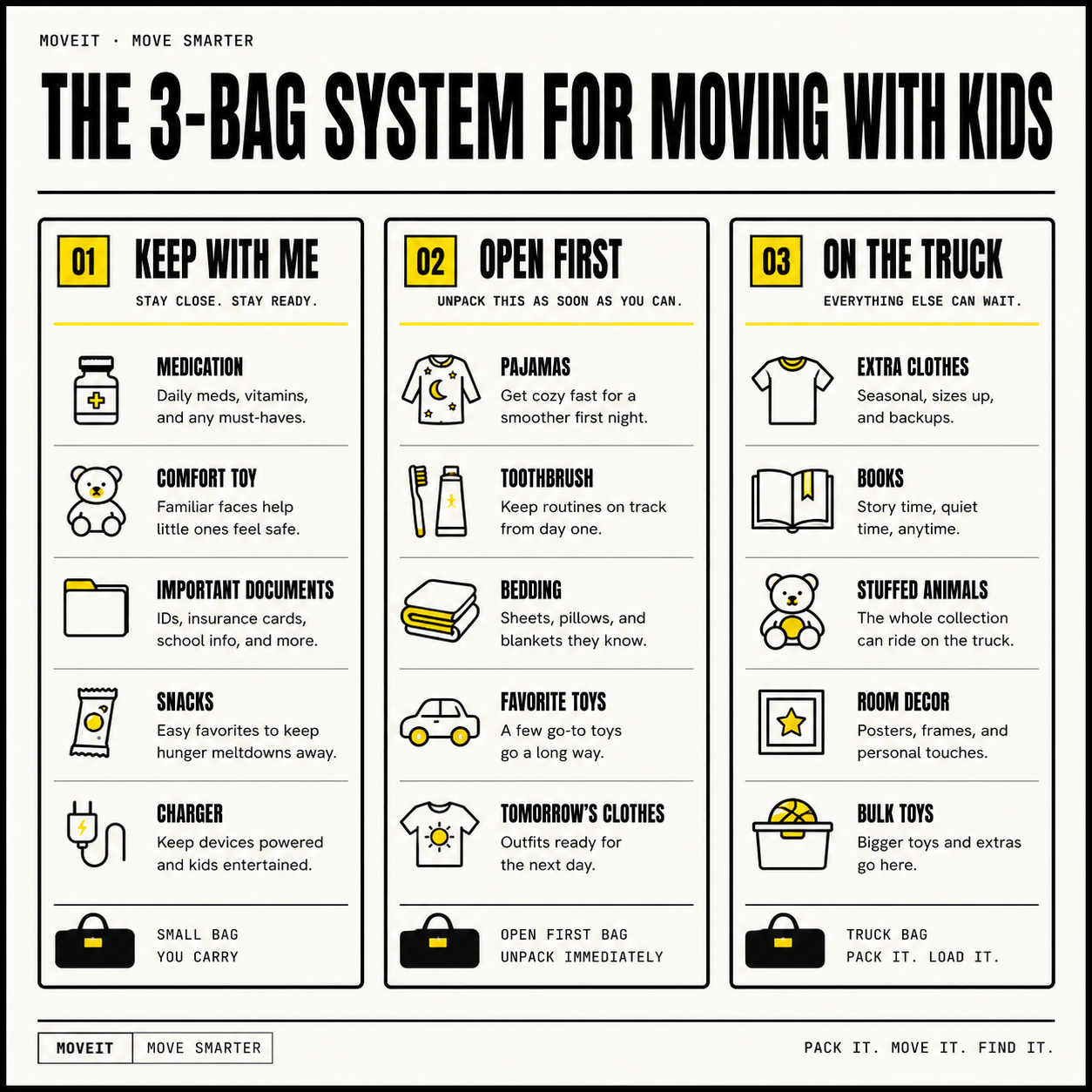
Before packing your child's room, separate their belongings into three groups.
Not every item should travel through the move in the same way.
1. KEEP WITH ME
This is the small bag that stays with you — not on the moving truck.
Typical contents:
- Essential medication
- One comfort toy or blanket
- Important documents
- Snacks
- Water bottle
- Phone/tablet charger
- Diapers or changing supplies if needed
- A change of clothes
- Anything your child absolutely needs during the journey
If you are driving to the new home, this bag stays in the car.
If you are flying, it is carry-on territory.
If there is one rule here, it is simple:
Do not put medication, irreplaceable comfort items, or critical documents somewhere you cannot immediately reach them.
2. OPEN FIRST
This bag or box should be one of the first things accessible at the new home.
Think:
- Pajamas
- Toothbrush and toiletries
- Bedding
- Favorite bedtime book
- A few familiar toys
- Tomorrow's clothes
- Night-light
- School/daycare essentials
- A familiar cup or bottle
The goal is to be able to recreate one normal evening even if the rest of the house is still full of sealed boxes.
3. ON THE TRUCK
Everything else can travel normally:
- Extra clothes
- Books
- Most toys
- Room decor
- Seasonal items
- Bulk toy bins
- Extra bedding
These are important, but they are not urgent.
The distinction matters because during a move, priority without visibility is not really priority.
02Protect the Routine More Than the Scheduleexpand_more
Moving week rarely follows the clock perfectly.
Lunch may be late. Movers may arrive early. A closing may take longer than expected. Someone will probably ask where the tape gun is while holding the tape gun.
That is normal.
But even when the exact schedule changes, try to preserve the recognizable sequence of your child's day.
For younger children especially, predictable routines can create a sense of order during a big transition. Child Mind Institute specifically recommends keeping mealtimes and bedtimes as consistent as practical after a move, and the American Academy of Pediatrics notes that regular, predictable family routines help children feel secure.
You do not need military precision.
You need anchors.
For example:
Morning
- Wake up
- Breakfast
- Get dressed
- Explain what is happening today
Afternoon
- Familiar lunch
- Quiet time or nap
- One known activity
Evening
- Dinner
- Bath
- Favorite story
- Familiar bedding
- Same bedtime ritual
If bedtime normally includes the same book, stuffed animal, song, or night-light, those objects belong in the OPEN FIRST category.
Do not make yourself search through twelve boxes at 9:15 p.m. for the one stuffed rabbit that suddenly controls the emotional stability of the entire household.
03Give Kids a Job — But Not a Logistics Departmentexpand_more
Children often cope better with change when they have some sense of participation and control.
That does not mean asking a five-year-old to manage box reconciliation.
Give them a job that is:
- visible,
- achievable,
- age-appropriate,
- and unlikely to create more work than it solves.
Toddlers and preschoolers
Try:
- Putting stuffed animals into a box
- Choosing which toy travels in the KEEP WITH ME bag
- Adding a sticker to their OPEN FIRST box
- Picking the color for their room label
- Carrying one lightweight item
Elementary-age children
Try:
- Grouping books or toys
- Making a "keep / donate" pile
- Photographing the contents of a box with supervision
- Checking items off a simple list
- Choosing which five toys should be available first
Older kids and teenagers
Try:
- Packing their own non-fragile belongings
- Labeling boxes
- Keeping track of chargers and electronics
- Photographing valuable items
- Preparing their own first-night bag
- Helping map where boxes should go in the new room
Giving children choices also helps.
Instead of:
"Pack your room."
Try:
"Which three things do you want with you on moving day?"
That is a decision they can actually make.
04Pack the Child's Room in Layersexpand_more
One of the easiest mistakes is completely dismantling a child's room too early.
Instead, pack it in layers.
Layer 1: Things they will not notice
Start with:
- Outgrown clothes
- Seasonal items
- Extra books
- Rarely used toys
- Wall decor
- Storage bins
- Extra bedding
This lets packing begin without instantly making the room feel empty.
Layer 2: Things used occasionally
A few days before moving:
- Most toys
- Most books
- Extra clothes
- Craft supplies
- Larger play items
Leave a small "working set" available.
Layer 3: Last-night items
Pack these last:
- Favorite stuffed animal
- Pajamas
- Night-light
- Current bedtime books
- Tomorrow's clothes
- Toiletries
- Essential medication
- Comfort blanket
These become either KEEP WITH ME or OPEN FIRST items.
The room can slowly become packed without abruptly removing every familiar cue at once.
05Make Comfort Items Impossible to Loseexpand_more
A child's comfort object can look unimportant to everyone except the child.
Treat it accordingly.
If your child has a particular stuffed animal, blanket, toy, book, or sleep item they regularly depend on:
Do not pack it into general cargo.
Keep it physically with you or put it into a clearly identified bag that you control.
If there are two similar comfort objects, moving week is an excellent time to know where both are.
You can also photograph particularly important items before moving. That is useful both for remembering what went where and for documenting condition when appropriate.
MoveIt users can record box contents and photos, but even if you are using paper labels, the underlying principle is the same:
The more important the item, the less ambiguity you should tolerate about where it is.
06Create One "Normal Evening" Before You Unpack the Houseexpand_more
Your first goal after arriving should not necessarily be to unpack the kitchen or make the living room Instagram-ready.
For a family with young children, a better first milestone is:
Can we run bedtime?
Set up enough of the child's room to make it recognizable:
- Bed or sleep space
- Familiar bedding
- Pillow
- Night-light
- Comfort items
- Pajamas
- Toiletries
- A few favorite books or toys
Child Mind Institute specifically recommends putting familiar bedding and belongings out early after a move.
The entire room does not need to be complete.
It needs to feel known.
Once the kids are asleep, you can return to the exciting adult activity of wondering why the box cutter has vanished again.
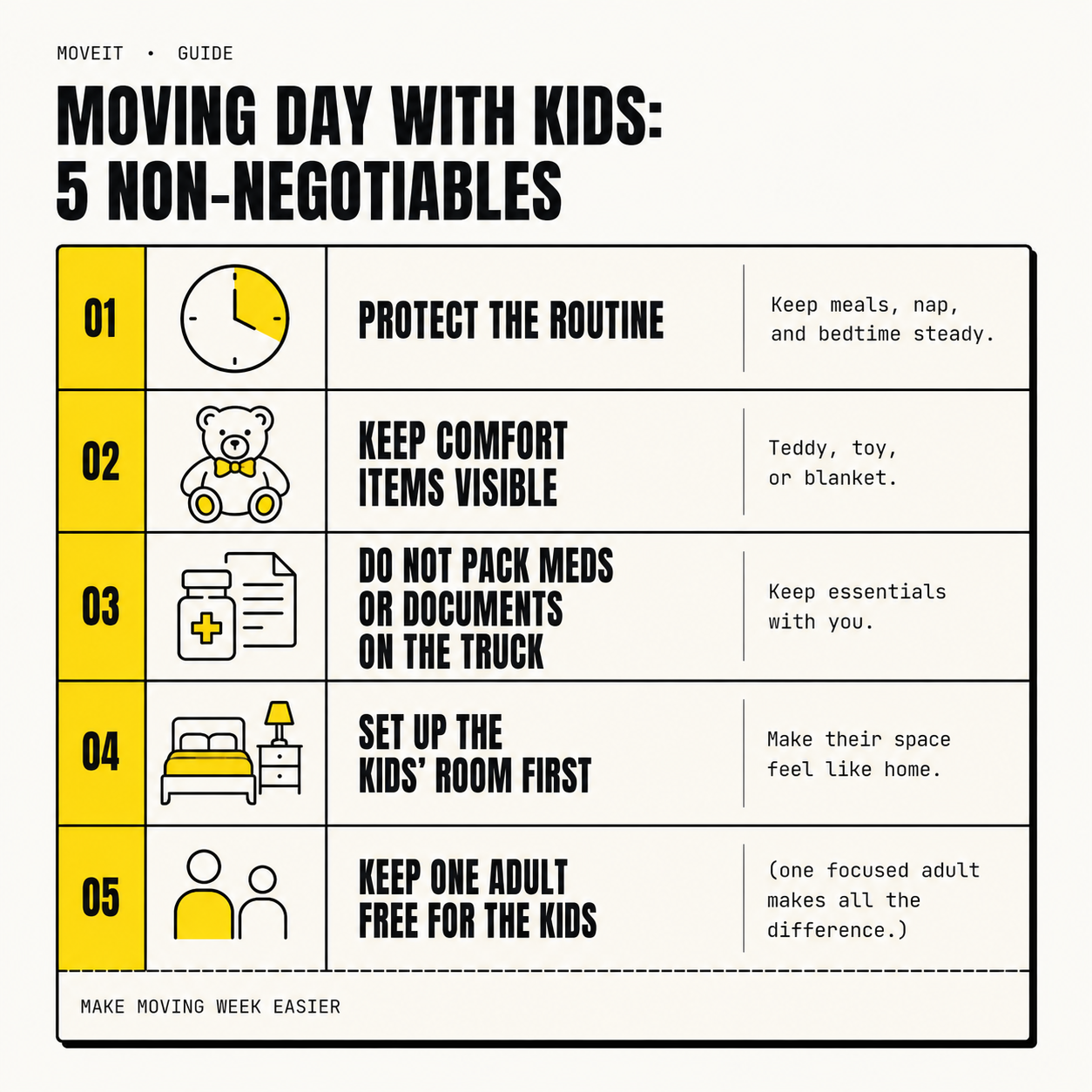
07Moving Day With Kids: 5 Non-Negotiablesexpand_more
1. Protect the routine
Keep the main anchors — meals, naps, bedtime, familiar rituals — as steady as reasonably possible.
2. Keep comfort items visible
Do not put the favorite teddy, blanket, or bedtime book somewhere inaccessible.
3. Keep medication and important documents with you
These should not be loaded onto the truck with ordinary household belongings.
4. Set up the kids' sleeping space early
You do not need to finish the room. Get the essentials ready before everyone is exhausted.
5. Keep one adult available for the children when possible
If two adults are present, avoid having both completely consumed by mover logistics at the same time.
If you have help available from grandparents, relatives, friends, or childcare, moving day is an excellent time to use it.
08Build a Kids' OPEN FIRST Boxexpand_more
Here is a practical starting checklist.
Sleep
- Pajamas
- Familiar sheets
- Pillow
- Blanket
- Night-light
- Bedtime book
- Comfort toy
Clothing
- Clothes for the next day
- Underwear
- Socks
- Weather-appropriate outerwear
Bathroom
- Toothbrush
- Toothpaste
- Hairbrush
- Bath essentials
- Diapers/pull-ups if needed
- Wipes
Food
- Favorite snacks
- Water bottle
- Child cup/bottle
- Easy breakfast item
Daily life
- Chargers
- School/daycare bag
- A few favorite toys
- Current book
- Any must-have routine item
Keep with the parent — not in this box
- Medication
- IDs/passports
- Insurance information
- Important school/medical documents
- Irreplaceable items
09Label Children's Boxes for the Person Unloading Themexpand_more
A label should not require the person carrying the box to know your family.
Instead of:
EMMA
use:
BEDROOM 2 / EMMA / BOOKS
Instead of:
KIDS STUFF
use:
BEDROOM 2 / TOYS / OPEN WEEK 1
Instead of:
IMPORTANT
use:
BEDROOM 2 / OPEN FIRST / BEDDING
That way a mover, relative, friend, or anyone helping can make the correct decision without asking you.
If you are using MoveIt, this is where destination information, box IDs, searchable contents, photos, and mover-facing scans become useful.
But the physical label should still make sense by itself.
Technology should reduce ambiguity — not create a new dependency.
10Photograph the Things You Will Otherwise Forgetexpand_more
You do not need to photograph every sock.
Focus on things where a visual record is genuinely useful.
Examples:
- Contents of mixed toy boxes
- Electronics and their cables
- Expensive toys or devices
- Furniture condition
- Serialized electronics
- School materials
- Boxes containing many small items
Photographs serve two purposes:
- They help you remember what you packed.
- They reduce the need to reopen boxes simply to check what is inside.
That can matter a lot when a child suddenly asks for something very specific.
11Plan for the First Morning Tooexpand_more
Most people plan for the first night.
Then morning arrives.
Before going to sleep, make sure you can answer:
- What are the kids wearing tomorrow?
- Where are toothbrushes?
- Is breakfast possible?
- Where are school/daycare bags?
- Where are shoes?
- Where are medications?
- Are chargers accessible?
- Do we know where the car keys are?
Your OPEN FIRST system should cover roughly the first 24–48 hours, not merely bedtime.
12After the Move: Let the Room Become Theirs Againexpand_more
Once the essentials are established, involve your child in setting up the new space.
Depending on age, let them choose:
- Where a toy bin goes
- Which wall gets their pictures
- Where books live
- Which bedding to use
- How a desk is arranged
- Where favorite objects are displayed
This gives them some ownership over a transition that was largely decided by adults.
Child Mind Institute recommends giving children age-appropriate control during a move, including participation in packing and decisions about their new room.
For older children, the adjustment is not only about belongings. Friends, school, activities, and identity may matter much more than boxes.
Make room for that conversation too.
13A Simple Moving-Week Timeline for Familiesexpand_more
| Timing | What to do |
|---|---|
| 2–4 weeks before | Talk about the move, involve kids in small decisions, begin packing low-use belongings. |
| 1 week before | Build KEEP WITH ME and OPEN FIRST lists. Confirm medication, documents, school/daycare needs. |
| 2–3 days before | Pack most remaining toys/clothes. Keep routine items accessible. |
| Night before | Prepare travel bags, tomorrow's clothes, chargers, comfort items and snacks. |
| Moving morning | Keep children's essentials physically separated from truck cargo. |
| Arrival | Set up beds/sleeping spaces and bathroom basics before nonessential unpacking. |
| First evening | Resume familiar dinner/bath/story/bedtime sequence where practical. |
| First week | Let kids participate in setting up their rooms and resume normal activities. |
14The Goal Is Not a Perfect Moveexpand_more
Children do not need every box unpacked.
They need to know where their favorite blanket is.
They do not need a perfectly organized kitchen on night one.
They need dinner, pajamas, a toothbrush, and some version of the bedtime they recognize.
And parents do not need another impossible standard to meet during moving week.
The point of a good moving system is to remove decisions when everyone is already tired.
Decide what stays with you.
Decide what opens first.
Label everything else clearly enough that another person can put it in the right place.
Then let the move happen.
15Where MoveIt Fitsexpand_more
MoveIt was built around a simple problem: once something goes into a sealed box, the information about it usually disappears.
With MoveIt, you can photograph what you pack, keep a searchable record of box contents, assign boxes to rooms, and make destination information available during the move.
For families, that can mean being able to answer a surprisingly important question quickly:
Which box has the thing my kid needs right now?
Pack it. Move it. Find it.
16Frequently Asked Questionsexpand_more
What should I pack separately when moving with kids?
Keep essential medication, important documents, irreplaceable comfort items, snacks, water, chargers, and immediate travel needs with you. Separately prepare an OPEN FIRST bag or box containing pajamas, toiletries, bedding, tomorrow's clothes, and a few familiar toys or books.
How do I make moving less stressful for children?
Talk about the move in advance, give children age-appropriate choices, preserve familiar routines where practical, keep comfort objects accessible, and re-establish familiar belongings soon after arrival. If your child is struggling significantly with the transition, consider discussing it with their pediatrician or another qualified professional.
Should kids help pack for a move?
Usually, yes — at an age-appropriate level. Younger children can choose toys or add stickers to boxes; older children can pack, label, photograph, or organize their own non-fragile belongings. Giving children some control can make the transition feel less passive.
What should be unpacked first when moving with children?
Start with sleeping spaces, bathroom basics, medications and essential daily items. For children, familiar bedding, comfort items, pajamas, toiletries and a few favorite books or toys are usually higher priority than fully unpacking the entire room.
Should children's medication go on the moving truck?
No. Essential medication should remain with the responsible adult during the move rather than being packed with ordinary household cargo.
How early should I pack my child's room?
Pack low-use and seasonal items first, then gradually reduce toys, books and clothes. Leave familiar bedtime items, comfort objects, toiletries and next-day clothing until the very end.
18Use this with MoveItexpand_more
- Moving inventory app keeps open-first kids’ boxes searchable instead of anonymous cardboard.
- QR moving labels put floor and room on the sticker so a tired crew is not guessing which bedroom.
19Sources / Editorial Referencesexpand_more
This article is practical moving guidance, not medical advice. Parenting and routine recommendations were informed by:
See how MoveIt works →All posts
More packing notes
Packing · August 31, 2026
What to pack first when moving
Open-first boxes, first 72 hours, and what should never go on the truck.
Labels · August 31, 2026
How to label moving boxes so movers put them in the right room
A labeling system that works on moving day: room codes, handling flags, and QR codes on Avery 5163 labels.
Inventory · August 31, 2026
Moving inventory checklist
What to photograph, what to write on the box, and what to export before the truck arrives.